People are talking about
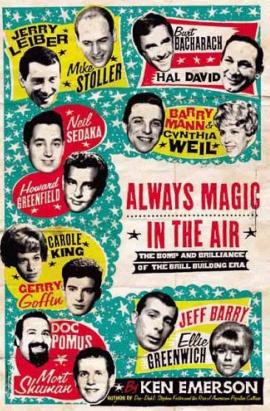
Ken Emerson’s Always Magic in the Air: The Bomp and the Brilliance of the Brill Building Era:
“Emerson’s affection
for his subjects and the music they created permeates his narrative and makes me want to revisit every little 45 rpm masterpiece
I own.”—John Kehe, Christian Science Monitor
“Superb…. Skeptical,
witty, in love with the music, Emerson is the ideal companion….” –James Parker, Boston Globe
“Emerson's book is just
about everything you could wish for. Love and clear-sightedness may be the most delicate of all critical balancing acts. For
Emerson, it's his true north, the critical compass that makes you believe you're reading a man you can trust…. Emerson
makes you believe you can hear the world in a pop song, even a world that's lost.”—Newsday
“Fascinating characters.…
Emerson takes flight when describing the cosmopolitan musical mixtures that defined the best work of the Brill Building set….
Here we get the whole tale in a single entertaining package.”—Jim Windolf, The New York Times Book Review
“Again
and again in "Always Magic in the Air," his engrossing account of the early days of rock and pop music, Ken Emerson puts you
at the moment of creation…”—David Kirby, The Chicago Tribune
And so is Ken Emerson:
Fans of these pages are among
the select few who will recognize the origins of my book’s title and subtitle: the second line of “On Broadway,”
first sung by the Drifters and written by Barry Mann, Cynthia Weil, Jerry Leiber and Mike Stoller; and the title and refrain
of Barry Mann’s biggest (and only) hit as a performer, “Who Put the Bomp (in the Bomp, Bomp, Bomp),” which
he wrote with Gerry Goffin.
Mann, Weil, Leiber, Stoller
and Goffin are five of the great songwriters whose heyday in the late 1950s and early 1960s I chronicle in Always Magic
in the Air. The others are Carole King, Burt Bacharach, Hal David, Doc Pomus, Mort Shuman, Howard Greenfield, Jeff Barry
and Ellie Greenwich.
Having written a book about
pop songwriting in the middle of the 19th Century, Doo-Dah!: Stephen Foster and the Rise of American Popular
Culture, I wanted to follow it up with a book about pop songwriting in the middle of the 20th Century that would describe how
much and how little had changed.
My book is based on scores
of in-depth interviews with songwriters, producers, engineers, publishers, attorneys, performers, ex-wives—everyone
from Fabian to Shadow Morton who has insights, information and stories to tell about life in the Brill Building and nearby
1650 Broadway when writers huddled in cubicles there wrote a new chapter in the Great American Songbook and the soundtrack
for the baby boom generation. Once you’ve read the stories behind them, songs like “Save the Last Dance for Me,”
“Will You Love Me Tomorrow” and “Kicks” will never sound the same. Who’d a thunk, for instance,
that “Is That All There Is?” was all but cribbed from an 1896 short story by Thomas Mann?
I’ m eager to
tell all and spread the word in interviews for print and on the air. If you’re interested, please contact me through Oldies Connection webmaster Laura .