|
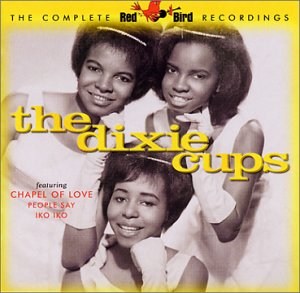
The Dixie Cups originally
consisted of sisters Barbara and Rosa Hawkins with their cousin, Joan Johnson. They were pursuing a singing career in
their native New Orleans under the name The Meltones. Singer/entertainer Joe Jones ("You Talk Too Much"), who discovered
the girls at a talent show, brought the trio to songwriter-producers Jerry Leiber and Mike Stoller at New York's Brill
Building. Leiber and Stoller, liking what they heard, decided to sign the girls to a
recording contract - and, with the decision having been made to start a new label to launch the new group, Red
Bird Records was born. The powerhouse songwriting team of Jeff Barry and Ellie Greenwich, who'd been working with Leiber and Stoller, joined Red
Bird as composers/producers.
"Chapel
of Love," written by Barry and Greenwich with Phil Spector, had previously been recorded by The Ronettes and The Crystals, but
neither version was released as a single. The girls recorded "Chapel of Love" under their new name, The Dixie Cups
(another name that had been briefly considered for the trio was Little Miss and The Muffets; the moniker decided
upon was a nod to the girls' New Orleans roots). Red Bird partner George Goldner heard The Dixie
Cups' master of "Chapel of Love" and declared it to be a sure-fire hit, so after augmenting the track with a Dixie-flavored
brass section, Leiber and Stoller released "Chapel" which ascended swiftly to #1 in the spring of 1964, knocking The Beatles'
"Love Me Do" out of the top spot and earning the girls their first gold record. Thus The Dixie Cups were the first American
group to "take back" the U.S. Cash Box and Billboard charts from the British Invasion.
The Dixie Cups' next release, "People
Say," garnered a second gold record for the group. Other hits would follow, like "You Should Have Seen the Way
He Looked At Me," "Little Bell," and the delightful chant "Iko Iko," which along with "Chapel of Love" has become the
group's signature tune.
In 1965, The Dixie Cups' manager tried
moving the group to another label, ABC-Paramount. Within a year or two stress from traveling led Joan Johnson
to retire from the group. Barbara and Rosa brought in another alto and continued to tour and entertain.
However, legal problems caused by The Dixie Cups' migration to the new label were enough to stall the trio's career and
cause their records to be dropped from the charts. Despite having a couple of Top Forty hits, the group was unable to
recapture the success they'd enjoyed at Red Bird and their recording career came to a halt.
The Hawkins sisters returned to New
Orleans in the late 60's, a decision fueled by manager problems. Rosa Hawkins found work as a model and also taught
modeling at the Barbizon and John Casablanca Schools. In addition, she worked as a makeup artist for Fashion
Fair Cosmetics and for Revlon. Rosa taught Barbara the makeup business, and Barbara too became a makeup artist, working
for these same companies. They also continued to perform around the world. During the 80's and 90's, thanks largely
to renewed interest in the songs they'd recorded for Red Bird, The Dixie Cups enjoyed a resurgence of popularity. In
2002, The Dixie Cups were Rhythm & Blues Foundation nominees; then, in 2003, the Foundation honored The Dixie Cups with their Pioneer Award. And, in 2007, The Dixie Cups
were inducted into The Vocal Group Hall of Fame.
Today, The Dixie Cups continue to perform
on the concert circuit, thrilling audiences with their pristine harmonies. Current members of the trio are Rosa
and Barbara along with their sister from their Neville Brothers family, Athelgra Neville.
 |
|
This
web site is a tribute to a trio of lovely, talented, and gracious ladies, The Dixie Cups. The Dixie Cups are comprised of sisters Rosa and Barbara
Hawkins from the original lineup, and the newest Dixie chick, Athelgra Neville, whom the Hawkins ladies introduce as
"our sister from our extended family." The Dixie Cups are best known for hits such as "People Say," "Iko Iko," "You
Should Have Seen the Way He Looked At Me," and their classic hit, "Chapel of Love." All three ladies were displaced
after Hurricane Katrina swept through their hometown of New Orleans. The Hawkins sisters have relocated to Florida.
The
Dixie Cups are still performing and are available for public and private functions (concerts, weddings, corporate events,
etc.). Please email booking inquiries to thedixiecups@yahoo.com and someone from their organization
will get back to you.
Executive
Assistant: Paul Errante (646) 361-7583
|
The
Dixie-Cups, the act that launched Red Bird Records with the number one hit "Chapel of Love" and placed Jeff [Barry] and
I in a more serious light as producers, hold a special place in my heart. They were the shyest, sweetest and most cooperative
group I had ever come across and working with them was a lot of fun - plus you rooted for them, wanting them to be successful.
I guess for lack of a better word, they exuded innocence and were in total awe of being in the recording studio. They listened,
they performed and their sound was totally street. What you heard was who they were and what they were all about and they
just sang from the heart. I'm really glad they have a legacy - from "Chapel of Love" - the first US record to hit #1 and break
through the 'British invasion of the charts,' to "Iko, Iko," one of the most memorable songs of New Orleans folklore. They
deserve the recognition and respect.
|
|
|
|
|